Showing posts with label Books. Show all posts

Thursday, June 20, 2013

The Pleasures of Man of Steel and Inferno

This week I shed my elitist philosopher persona and drank deeply from the well of popular culture.  I bribed my kids to do some work for me around the house by taking them to the new Superman film.  And for Father's Day they got me the new Dan Brown thriller, Inferno, which I read through in a few sittings.  The philosopher in me looks to books and films primarily for profundity, complexity, and subtlety.  And perhaps the best way to measure my estimation of these qualities in such media is how many times I re-read or re-watch them.  I have no plans to re-read Inferno or re-watch Man of Steel.

That's not to say that I didn't enjoy them at some level.  I also enjoy at some level sitting on the couch and eating an entire bag of potato chips while I watch those shows about aliens having visited earth (yes, we signed up for cable again).  But after such experiences I can't help wondering whether there are better pleasures to be had than these.  That's a tough argument to make, but one that has some plausibility to it.  We'll come back to that point.

Both of these stories brought up the theory of utilitarianism.  Should Superman ally with his fellow Kryptonians and take over Earth to repopulate their species?  Yes, it would hurt a bunch of humans, but if it resulted in more good (= life) for the most Kryptonians possible, then wouldn't it be worth the cost to humans?  Wouldn't we feel little pang of conscience to sacrifice a bunch of lower life forms to save our species?  Or switching to Inferno, Dan Brown's conspiracy du jour is that it has been mathematically demonstrated that the current overpopulation of the earth will lead to the extinction of human beings within 100 years if we don't do something drastic.  So utilitarianism would suggest that eliminating 1/3 of humans now is justifiable if it saves more people than that in the future.  This is the straightforward "moral" reasoning of Jack Bauer, et. al. in 24: if torturing a guy's kids gets him to tell us where the bomb is in the shopping mall, then shouldn't we do that so it will save lives?

Unfortunately the calculus of utilitarianism is never quite so simple.  Early on, J.S. Mill realized that we can't just calculate how much good or pleasure some action brings about, because it seems like there are different kinds of pleasures.  And he advocated that some of these pleasures are better than others.  And since was an elitist philosopher guy, the best pleasures ended up being those profound, complex, and subtle experiences that can be appreciated such folks.  So the pleasure of a listening to a Beethoven symphony is better than the pleasure of watching two super heroes duke it out for the last hour of that movie.  Or so the argument went.

I have to say I'm sympathetic to this argument at some level.  There was an experiment with mice in which they hooked up some electrodes to the pleasure center of their brains and the mice could learn to active this by pressing a button in their cage.  Once they learned how to do it, they sat there and pressed the button repeatedly until they died (because they didn't stop to eat or drink or sleep).  Is that kind of pleasure good?  Aren't there better kinds?

Reading Dan Brown is kind of fun.  The three page chapters pull you along through the plot at a break-neck speed.  You want to find out where the bag of plague virus is hidden, and you want to find out who is the double-crosser, etc.  There's not much work to reading it.  And I suppose you get out of it what you put into it.  Whenever I've put in the effort to read something harder, though, I find that much more rewarding in the end.  Not everyone has the taste for Anna Karenina, but profundity, complexity, and subtlety are found in much more abundance there.  The same is true for gruyere cheese compared to the nacho cheese dip at the 7-eleven, and for chess matches compared to the NBA, and for reading good blogs compared to watching YouTube.  Should we elitist snob types try to force the good stuff on everyone, or even make the claim that one really is better than the other?

I don't know.  I'm in the mood for a bag of chips.

Thursday, January 3, 2013

Happy Birthday J.R.R. Tolkein!

On this day in 1892, John Ronald Reuel Tolkein was born in South Africa.  That means that ten years ago today would have been his eleventy-first birthday!  That's one of my favorite neo-logisms to come from his books (along with "second breakfast").

I almost didn't want to go see the current cinematic version of The Hobbit.  I was a pretty big fan of the Lord of the Rings movies, thinking they got the epic scope of the story just right as well as the intimacy of the characters.  And the visuals were fantastic.  But of course the movie makers succumbed to Hollywoodization in several places that left me scratching my head.  And that is what concerned me about what they might do to The Hobbit.

I've read the book three times--first during my college years; then I read it aloud to my class of 7th and 8th graders in Africa in the fall of 1991; then my good wife and I read it to each other in 2001 before the trilogy movies started coming out.  The Hobbit is very different in feel from the trilogy.  I'm afraid the movie doesn't feel any different.  Of course the visuals are still very cool (we saw the 3D version)--especially the beginning with the back story of the Dwarf kingdom under the mountain.  But it feels to me like Peter Jackson et al. said, "Hey, our LOTR trilogy was fantastically successful, so let's apply the same formula and do it again."  There is too much fighting and not enough singing (though the new rendition of "That's What Bilbo Baggins Hates" was pretty good).  Look at the movie poster.  Is that really what the book connotes?

I thought Martin Freeman made a pretty good Bilbo.  I really like Freeman as Dr. Watson in the British Sherlock series.  It is interesting that he is very much the same character there as he is with Bilbo.  I guess most actors tend bring their acting baggage with them into new roles (with the notable exception of Matt Damon).

I'm sure I'll see the other movies.  Just like I'm sure I'll go see the Ender's Game and Silence movies when they're made.  But I have a reputation to keep up as an elitist snob who thinks books are better than movies.  So I'll go ahead and reveal to you right now that those books are better than their movies too!


Monday, December 31, 2012

2012 Reads

It's an end-of-year tradition for me to comb back through my reading journal and see how many books I've read during the year.  In my line of work I flip through and sample lots and lots of books during the year, but for this exercise in anal retentiveness, I only count those that I read cover-to-cover.  In that grand blogging tradition of spilling one's guts to one's reading public (or is it the grand blogging tradition of thinking people actually care to hear personal details of one's life??), I offer my list here for your consideration:
  1. Christopher MacDougal, Born to Run
  2. Alvin Plantinga, Where the Conflict Really Lies
  3. Margaret Atwood, The Handmaid’s Tale
  4. Orson Scott Card, Ender’s Game (Kindle)
  5. Alexander McCall Smith, The Forgotten Affairs of Youth (re-read)
  6. Peter Enns, The Evolution of Adam
  7. Mary Doria Russell, The Children of God  (Kindle, re-read)
  8. Yann Martel, Beatrice and Virgil
  9. Plato, The Trial and Death of Socrates  (re-read)
  10.  Michael Green, Engaging Philosophy
  11. T.H. White, The Once and Future King
  12. Harry Lee Poe and Jimmy Davis, God and Cosmos
  13. Lawrence Krauss, A Universe from Nothing
  14. Jim Nolt, Why Does the Universe Exist?  (Kindle)
  15. P.D. James, The Private Patient  (CD)
  16. Leif Enger, Peace Like a River (CD, re-read)
  17. Spencer Wells, The Journey of Man: A Genetic Odyssey
  18. Alexander McCall Smith, The Right Attitude to Rain (re-read)
  19. Jason Rosenhouse, Among the Creationists: Dispatches from the Anti-Evolutionist Front Line
  20. Alister McGrath, Surprised by Meaning: Science, Faith, and How We Make Sense of Things
  21. Alexander McCall Smith, The Uncommon Appeal of Clouds
The list is never as long as I think it should be.  If I added up all the hours represented there in reading, would it be as many hours as I spent watching TV?  Given that this was an Olympic and European Cup summer, I'm guessing not.

Then, I have a few reading rules of thumb (which are constantly up for re-vision) that I try to allow to guide my reading habits.  Let's see how I did on these:
  1. Read at least as much fiction as non-fiction.  Looks like 10 to 11.  Close enough.
  2. At least 1/4 of books should be re-reads.  4 out of 21.  Close enough.
  3. Read at least as much by authors who are dead as by the living.  T.H. White and Plato seem to be the only corpses here (though P.D. James is 92 according to Wikipedia!).  Pretty pathetic.
  4. Re-read several from my two lists of life books, which (currently) are:
Pre-1900:
The Holy Bible
The Iliad, Homer
The Republic, Plato
Confessions, Augustine
Don Quixote, Cervantes
King Lear, Shakespeare
Rasselas, Samuel Johnson
The Brothers Karamazov, Dostoyevski
The Death of Ivan Ilych, Tolstoy
Heart of Darkness, Conrad 
Post-1900 Fiction:
  • The Great Gatsby, Fitzgerald 
  • Chronicles of Narnia, Lewis
  • Things Fall Apart, Achebe 
  • The Chosen, Potok
  •  Silence, Endo
  • 100 Years of Solitude, Marquez
  •  Name of the Rose, Eco
  • The Brothers K, Duncan 
  • The Sparrow and Children of God, Russell
  • Gilead, Robinson
    •  


On this rule of thumb I failed miserably.  The only one from both lists that I got in this year was Russell's Children of God (which is fantastic, by the way).  Though it is entirely possible that The Once and Future King makes its way onto the Post-1900 Fiction list (but who would have to leave??).  Pathetic!

And then finally, rule of thumb #5 is to read (or re-read) from my theological conversation partners, which currently are:  Dallas Willard, Leslie Newbigin, Stanley Hauerwas, and NT Wright.  How'd I do here?  A big goose egg.  Really, very pathetic!!

2013 New Year's Resolution #1:  Be a better reader!


Friday, November 16, 2012

Creationists R Us

Given the cablessness of our household vis-a-vis television (briefly described here), I've been getting more reading done lately.  My sports watching on the tube normally occurred with a book in my lap, but I'm pretty sure that I now have incontrovertible evidence that I do in fact read more quickly when I'm not watching TV at the same time.  Who woulda thought??

This week I got through one of those new books I got in the mail (mentioned here) a couple of weeks ago:  Among the Creationists: Dispatches from the Anti-Evolutionist Front Line.  It is by a mathematics professor at James Madison University by the name of Jason Rosenhouse, who is a self-professed atheist (though Jewish in cultural/religious background).  He got interested in creationism while holding a position at Kansas State University involved with implementing mathematics standards in public school education in Kansas.  He heard about a conference related to science education in Kansas, and on a whim decided to go.  It turned out to feature Answers in Genesis speakers like Ken Ham.  He reports from this conference, "It was clear that, from their perspective, evangelical Christianity was a tiny island of righteousness adrift in a sea of secular evil" (p. 3-4).  Thus began a fascination with that insular community by Rosenhouse, and he spent the next ten years going to their conferences.  The book is a collection of stories from these conferences and Rosenhouse's reflections on the movement.  He didn't become a Christian in the process, but some of his conclusions might surprise those who are members of the aforementioned insular community.  He says,
I do know these experiences have had a salutary effect on me.  It is far more difficult to caricature and stereotype people you have actually met.  Have a few conversations over lunch or during breaks at conferences, and suddenly they are no longer abstractions or types.  They are no longer defined by a few odd beliefs you have heard that they hold.  They become actual people, with depth and personality and reasons for the things they believe.  (p. 15)
The stories range through conferences like that one which was mostly propaganda, to the more scientifically serious conferences like the International Conference on Creationism, where credentialed scientists grapple with the science implied by their positions.  Rosenhouse discusses primarily the young earth variety of creationism, but also Intelligent Design and Evolutionary Creationism (aka theistic evolution).  No matter where you fall on that spectrum, the book is worth reading.  His treatment is fair and illuminating.  On this latter point, the book is like a mirror being held up to someone who hasn't seen himself for awhile--perhaps he was stranded on a desert island for some years; he probably knew that he looked different than the image of himself he carried in his head, but actually seeing himself the way others do is undoubtedly a little startling. Rosenhouse paints an accurate picture of the way many of us look to outsiders.

On the former point--fairness--we only have Rosenhouse's versions of his conversations and interactions, but they sound entirely plausible from my experience.  And he is very quick to say that to the surprise of many, he was always treated well at these conferences, he was never boo-ed or hooted off the microphone during the question answer sessions, people entered into dialogue with him and sometimes admitted when he had exposed a problem with their thinking.

I certainly don't agree with everything he says, but his conclusion needs to be taken seriously.  Here it is:
Evolution challenges the claims of the Bible, refutes Paley's version of the design argument, exacerbates the problem of evil, and seems to diminish human significance.  Any one of these points is worrisome, but all four together amount to a strong cumulative case against the possibility of harmony between evolution and Christianity. (p. 218).
We in the Church cannot ignore books like this.  On that count, I've been invited to talk to one of the large Sunday School classes at my church on Sunday about evolution.  The talk is not going to be of the sort that merely claims evolution to be absurd and ridiculous.  It's not (referent of the pronoun intentionally left vague).  We need to figure out what to do about it. 

Sunday, November 4, 2012

New Book Alert

Continuing one of my least popular series of blog posts, here are some new additions to my library that arrived in the mail this week.  Guess what I'm working on...

  • Among the Creationists, by Jason Rosenhouse
  • American Genesis: The Evolution Controversies from Scopes to Creation Science, by Jeffrey P. Moran
  • Science and Christianity in Pulpit and Pew, by Ronald L. Numbers
  • The Creationists, by Ronald L. Numbers
  • Science and Religion:  A New Introduction, by Alister McGrath
  • When Science and Christianity Meet, edited by David C. Lindberg and Ronald L. Numbers
  • God, Humanity and the Cosmos, edited by Christopher Southgate.Rocks of Ages: Science and Religion in the Fullness of Life, by Stephen Jay Gould

Thursday, July 12, 2012

New Book Alert

The other day son #3 talked me into swinging by Steak and Shake for an afternoon milkshake.  When we got there, we saw that from 2-4pm it is milkshake happy hour, meaning that they are half price.  Well, it was 1:30, and being a natural-born cheapskate, I talked the aforementioned son to go across the parking lot to the bargain bookstore for half an hour before we imbibed (I mean, that was going to save me three bucks!).

I stop by the bargain bookstore every few months, and I'll often take a chance on some books I don't really know anything about.  Sometimes that pays off, and I find a gem of a book that opens up some new territory.  More often I leave with a pile of cheap books that get browsed through a bit, and then take up shelf space.  If I get anything, I'll usually get $15 worth of books so that I can get another punch on my "Bargain Books Reward Card."  After twelve purchase of $15 or more, you get a gift certificate for $20.  After several years of carrying the card around in my wallet (and forgetting to use it a few times when I could have) I now have 11 punches.  The payoff is so close I can almost smell it.

Here was the take away this time (for $14.20, after my 10% educator discount; and the nice lady still punched my reward card!):

What are People for?, a collection of essays by Wendell Berry.  The nicely crafted essay is one of my favorite genres of writing.  I've read a couple of Berry's novels, so I thought I'd give this a shot.  I read one of the essays the other day, "Wallace Stegner and the Great Community" because I've also read a Wallace Stegner novel (Crossing to Safety, which, by the way, is fantastic; it is about an English professor and two couples who are best friends; those of you in academia would find it very interesting).

I got a couple of books by contemporary theologians:  Barbara Brown Taylor Speaking of Sin: The Lost Language of Salvation and D. Stephen Long's The Goodness of God. I know a bit about each of these authors but have never read any of their books. For $1.40 and $1.80 (minus my 10% discount), I thought I'd take the chance.

Since finishing The Once and Future King the other day (see here for an account), I went looking for some of the classic Arthurian literature. Mallory's Morte d'Artur was what I was looking for. I found Lancelot of the Lake which says it was written in the early thirteenth century. I'm not sure how this is related to Mallory.

And then I got Tour de France for Dummies. As a way to prepare ourselves for the ridiculous amounts of television we'll be watching when the olympics start in a couple of weeks, my wife and I have been watching some of the TdF, but we only vaguely understand much of what we see. The book is four years old, but at only 99 cents (or rather 89.9 cents after the discount) it is worth every penny.

A couple of other book acquisitions this week:

It was my birthday yesterday, and my good wife got me a book she had seen listed on my OneNote mobile page, "Books I'm Interested in Acquiring." Not knowing that she had seen the list, I also ordered the book from Amazon earlier this week, because I needed one more to get the free shipping (back to the cheapskate thing).  Well, the one I ordered hasn't come yet, so her present takes precedence (and by next week, I'll have an extra copy of this book if anyone is interested):  Harry Lee Poe & Jimmy H. Davis, God and the Cosmos: Divine Activity in Space, Time and History.  I may do some separate blogs on this, as I think there are some ideas worth exploring.

Another part of my Amazon order came:  Science and Religion--1450-1900: From Copernicus to Darwin by Richard G. Olson.  I got it from the used selections at Amazon, and I'm not very happy to see that it has a bunch of highlighting in it.


Welcome to the family!

Sunday, June 24, 2012

New Book Alert

Besides editing the Blackwell Companion to Science and Christianity, I also wrote a chapter for it called "Natural Theology after Modernism."  The contributors to a volume like this benefit financially even less than the editors do.  They each receive a copy of the finished volume, and then $200 worth of books from Blackwell's book list.  I just received my shipment of them.

For such an occasion I usually take a few chances on some books or get some things that I wouldn't otherwise pay for.  Here's what I got:

World Philosophies: An Historical Introduction, by David E. Cooper.  A sweeping overview of the major systems of philosophy throughout world history, including significant representation of non-Western schools of thought.

The Classics of Western Philosophy, edited by Jorge Gracia, Gregory Reichberg, and Bernard Schumacher.  I'm a sucker for books like this.  It is not an anthology of primary sources, but a collection of original essays about the classic works.

The Meaning of Theism, edited by John Cottingham.  A collection of essays from a special edition of the journal Ratio.

A Brief History of Analytic Philosophy from Russell to Rawls, by Stephen P. Schwartz.  An aptly named book; it does what it advertises.

A Brief History of Spirituality, by Philip Sheldrake.  A survey of Christian spiritual writing from the New Testament through Thomas Merton.

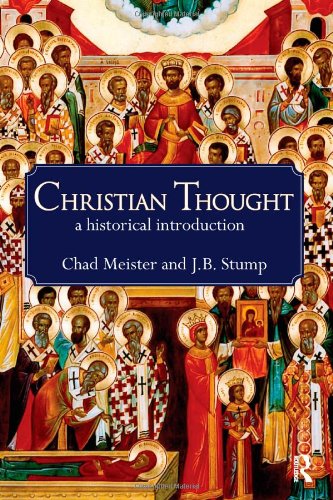
Then I bought two other books this week, and it may seem kind of funny that they were two copies of my own book, Christian Thought: A Historical Introduction.  I like to keep a few of these around to peddle to others.  As the author, they gave me 10 or so to start with, but now I have to pay 40% of the list price to get additional copies.  The bookstore at my institution was having a 50% sale this week because they are expanding the store (and, I guess, trying to get rid of their stock?).  So I could get them cheaper there.

Welcome to the family!

Saturday, May 12, 2012

Children of God

A couple of weeks ago, I posted (here) about Alan Jacobs's book, The Pleasures of Reading in an Age of Distraction.  I followed its advice about reading what you really enjoy.  So, since then I've ravaged my way through one of my all time favorites:  Mary Doria Russell's Children of God.  It is the sequel to her The Sparrow.  I reread that one last year, and so decided to reread the sequel too.  This is the kind of reading for me that just about all day long I'm thinking about the story, and planning my day so that I can get back to reading it asap.  Those must be the signs that a book is really clicking with you.

Russell used to be an anthropologist, but wrote The Sparrow as a way of working through her own religious beliefs.  She was raised Catholic, pretty much gave it up during her young adulthood and scientific career, then in the process of writing this book, converted to Judaism.  It is a science fiction story set just a few decades into the future when the SETI program hears a radio signal from an extra-terrestrial source with beautiful but haunting music.  The Jesuits (as they have been doing for centuries) decide that they're going to that other planet, and so ready an away team, which is centered on Emilio Sandoz, a linguist from Puerto Rico who has always struggled with his feelings toward God. Everything goes marvelously well... and tragically wrong.  The stories are the best treatment of the problem of evil that I have ever encountered.  And Russell is fabulously creative in imagining this other world and how the sentient creatures there might be, and how they might relate to a bunch aliens that show up on their planet.  The relativistic effects of interstellar travel also make for very intriguing reading.

I think there's something about (good) science fiction and the radical difference from our own world portrayed in them that shows most clearly what we're really like.  So, I'm now going to ignore Jacobs's advice and say that everyone should read these books!

Tuesday, May 8, 2012

A Glimpse into the (not so) Lucrative Business of Academic Publishing

In what may turn out to be an annual tradition (see here for last year's edition), I unveil some of the realities of the financial side of academic publishing.  My dissertation director at Boston University was good friends with Thomas Kuhn, who (at least in the mid-90's) held the record for the most sales of a book that had been published on a university press--The Structure of Scientific Revolutions (University of Chicago Press) which at the time had sold something like 7 million copies worldwide.  That is so many standard deviations from the norm that I'm not sure that there is a number for it.  By contrast, Richard Swinburne (who is something of a philosophical superstar) told me that his best selling book, The Existence of God (Oxford University Press) had sold something like 12,000 copies.

So, the end of April is when Routledge Publishers (not a university press, but an academic publisher nonetheless) reconciles its accounts for the previous calendar year with its authors.  That is the press that Christian Thought is published on, so I get a statement about how many books were sold, and how much money they'll send me for the hours of labor that went into it.  Starting in June I registered the book on a nifty website (somewhat misleadingly called "novelrank") that tracks sales on Amazon.  Amazon is notoriously stingy with their sales figures, but they update books' rankings every hour.  This website figured out a way to determine how many of your books have sold, by tracking these rankings.  The best ranking on Amazon that Christian Thought has gotten to since June is 26,487.  That was last August and September when about 50 were sold.  In June through December, 87 were sold on Amazon.com and another 38 on amazon's UK site.  So anyway, I was curious to see how that would relate to total sales.

According to the reckoning of the good folks at Routledge, there were 47 copies of the electronic book sold at an average price of 36.38 GBP (Routledge is from London, so everything is in pounds); that seems a little expensive since the Kindle version is usually going for just over $30.  But hey, I'll take it.  There were 11 hardbacks sold at an average price of 52.12 GBP.  There were 465 paperbacks sold at an average price of 18.93 GBP.  That makes for a total of 523 books sold in 2011.  My co-author and I split 10% royalties on the electronic and paperback versions, and we split 7.5% on the hardbacks.  If you do all the math and convert the GBP to USD, you'll end up with a payday in the high three figures.  That's nothing to sneeze at, and it's certainly enough to take my family out to dinner at a restaurant with menus and waitstaff.  But we're not exactly buying a condo in Del Bocca Vista.

I'm anxious to see how the sales numbers go this year.  Will they continue to decline (sales figures in 2010 were 772)?  Or will they gain steam with textbook adoptions?  We completed all the work for a companion website (which can be found here) that looks pretty snazzy, and the Routledge people said they'd do another round of marketing for it as a textbook.  It would be nice to see several large universities adopt it, or perhaps it could become the official historical theology textbook of major league baseball.

Tuesday, March 13, 2012

New Book Alert

Since I started up the blogging discipline again, I've forgotten that one of my usual features used to be the "New Book Alert".  I still have several sitting on my desk that have come my way recently, so let me introduce you to them:

Whose Community? Which Interpretation (Baker Academic, 2009) by Merold Westphal.  He is a Christian philosopher who has been largely out of the limelight emitted by the Reformed and analytic bunch of the last generation.  But when I was down at the WPS, he was the keynote speaker, and I think he is a first rank Christian philosopher in Continental vein.  (At least he explains the stuff so I can understand it!)

A couple of weeks ago, I got a gift certificate to our campus bookstore for participating in some thing.  Sadly I didn't find many books that interested me on the shelves devoted to the general reading public.  So I went to the textbook section and in the required texts for a couple of Meister's classes I found Keith Ward's More than Matter?: Is There More to Life than Molecules (Eerdmans, 2010) and Why There Almost Certainly is a God: Doubting Dawkins (Lion, 2008).

Speaking of Meister, he gave me his latest offering hot off the press: Evil A Guide for the Perplexed (Continuum, 2012).  I read and commented on most of it while it was in manuscript stage.  It is always fun to see such projects packaged properly with a legitimate publisher.

I picked up a few science and religion books when I was writing my seminar paper a few weeks ago:  Toby Huff, Intellectual Curiosity and the Scientific Revolution (Cambridge UP, 2011); Donald S. Lopez Jr., Buddhism and Science: A Guide for the Perplexed (no relation to Meister's perplexing guide) (U of Chicago, 2008).  The novelist Herman Wouk, wrote an interesting memoir about science and religion called, The Language God Talks (Little, Brown, & Co, 2010).  Rosenblum and Kuttner, Quantum Enigma: Physics Encounters Consciousness (Oxford UP, 2011).  Then there is the book that is causing fundamentalists and half the evangelicals to get their panties in a bunch: Peter Enns, The Evolution of Adam: What the Bible does and doesn't Say about Human Origins (Brazos, 2012).

Finally, I picked up some used novels by Margaret Atwood.  I've never read her work, but have encountered it occasionally.  I'm about halfway through The Handmaid's Tale, which is a dystopian story in which radical right wing fundamentalists have somehow come to power (I suspect a nuclear war) and radically subjugate women.  A sort of sequel to that is her Oryx and Crake, and then a more recent one that (I gather) has themes of science and religion, The Year of the Flood.

So many books, so little time... 

Sunday, March 11, 2012

Finally Finished with Trollope

A few years ago I was at a conference on character education at Baylor.  Two of the main speakers were Stanley Hauerwas and David Solomon, and I heard both of them say that the best way to educate someone in character development would be to have them read a bunch of Anthony Trollope novels.  Never having read any Trollope, but usually appreciating 19th century literature, I came back and went to the bargain bookstore where I found a bunch of said novels (though I'm not sure the bunch I located was the right bunch...).

I was intrigued with the Barchester series he wrote, because supposedly it was inspired by the the Salisbury Cathedral in England (pictured), which I had visited recently.  It is a massive structure in an otherwise sleepy little town.  The events of the novels are structured around the ecclesial families of the town and the rather complicated relationship with the government.  I read the first book in the series, The Warden, pretty quickly and appreciated the moral dilemma the main character faced.  The other books were much longer, though, and so I put them off until some other time (though my wife read through a couple of shelf feet worth of these).

This past Christmas break I picked up the next one, Barchester Towers, and started in.  It didn't quite grab me, but I plodded on, ignoring Robby Prenkert's advice about reading things you're enchanted by.  There have been quite a few novels I've started and given 50 or 100 pages, and then called it quits because I wasn't enchanted (A Tale of Two Cities comes to mind here).  But this one, I felt I should keep reading because it wasn't just a diversion or entertainment, it was supposed to be character formation.  So, it stayed on my nightstand in the company of several other books that I dip into occasionally.  Well, finally I finished it yesterday, taking it with me to Ft. Wayne for a couple of my son's soccer games.  I'm guessing that the only character formation that happened was some bit of patience or perseverance.  Otherwise I was mostly annoyed with it.  Sorry Hauerwas and Solomon.  I'm on to other more enchanting books.

Wednesday, July 27, 2011

New Book Alert

When we were in northern Michigan for the Ron and Nancy Stump 50 year party, I sauntered into the Horizon Books one morning in lovely downtown Petoskey.  I had a rather strict time limit in the store, so I headed straight for the signs pointing the way to the bargain section down in the basement.  I'll often take a chance on some bargain books, knowing that I'll never read all of them that I buy, but quite often one will surprise me and contribute mightily to my ongoing education.  The bargain pickings were rather slim in that Petoskey basement, but for the prices I couldn't pass up a few interesting titles from the religion/philosophy section:

Larry Witham, The Measure of God: History's Greatest Minds Wrestle with Reconciling Science and Religion.  This is essentially a history of the Gifford Lectures (see short comments about that here).  This probably has the most promise among the new books for being read in its entirety.

Same guy, The Proof of God: The Debate that Shaped Modern Belief.  Turns out that this is a sort of history of the Ontological Argument.  My Aunt Pat should be interested.

Gustav Niebuhr, Beyond Tolerance.  The grandson of the famous theologian H. Richard Nihbuhr (of Christ and Culture fame) writes about interfaith understanding in America.

Jerry Walls, Heaven: The Logic of Eternal Joy.  A friend of mine who wrote this book, then Hell, and soon to be released: Purgatory.

Sian Griffiths, Predictions: 30 Great Minds on the Future.  Short essays on what they think will happen in the future, we'll all be driving flying cars, etc.


Sunday, May 29, 2011

Books I've been Reading this Week

Continuing the natural theology research, I've been skipping around in quite a few academic books I got from the library.  One of these I read this week was Stanley Jaki's Lord Gifford and his Lectures. It wasn't for studying, but just for fun to see something of the background of the prestigious Gifford Lectures.  It's now on my bucket list to go and attend them in Scotland someday.

Finished (re)reading McCall Smith's The Sunday Philosophy Club.  For every one of the books in this series, I get about 2/3 of the way through reading occasionally, and then I can't put it down until I'm done.  He's not Tolstoy, but I really enjoy the stories and quasi-philosophical reflection.


Another reread this week was Hearing God by Dallas Willard.  More on this in later posts.


Finally, Parallel Worlds by Michio Kaku.  That's one of the new books I talked about here.  I've gotten through about 100 pages of it so far.  It's a lay-friendly tour of 20th century cosmology so far.  "Lay friendly" in these books usually means an absence of mathematics.  Unfortunately trying to explain the latest theories in cosmology without mathematics is like trying to describe what a sunset looks like to a blind man.

Thursday, May 26, 2011

New Book Alert

It's always fun to get new books in the mail.  It wasn't that long ago that such a thing was a very rare occurrence.  When we lived in Boston during graduate school years, I used to make a fairly regular trip the used bookshops in Cambridge.  At the time, it had the highest concentration of bookshops of anywhere in the world.  I wonder how many of those are still open?

It was also during graduate school that I first remember hearing about Amazon.com.  Someone was handing out bookmarks in the library with advertisements for this new website.  I still remember a long river on the bookmark resembling the Amazon, and the catch phrase about the new Amazon.com as the world's largest book retailer.  I thought, "That is a really, really tenuous connection.  Surely they could have come up with a better name.  This one will never work."  So how much money have you contributed to the good folks at Amazon since then?

My latest purchases were two book on the multiverse--the latest conjecture of cosmologists that is a result of string theory and the inflationary universe.  Several papers in my Blackwell Companion discuss it, and I've been very interested.  So the latest edition to the Stump library are Michio Kaku's Parallel Worlds and Brian Greene's The Hidden Reality.  Kaku is the Japanese-American who is on just about every science show these days, and Greene is the new wunderkind of string theory from Columbia U.  Greene actually believes that there are an infinite number of worlds out there, and every variation of things that could possibly happen here are actually happening in one of them.  That means that there is really another planet out there where a middle-aged, balding philosophy professor writes a blog named Stump Speeches, but his has millions of followers.  I'm anxious to dive into his book--I suppose the me in another world has already finished it.  I'm sure I'll discuss it here in the future.

Sunday, May 22, 2011

Books I've been Reading this Week

I've been working on a paper I'm calling "Natural Theology after Modernism" this week that will go into the Blackwell Companion to Science and Christianity, which I'm editing with Alan Padgett (more on that later).  Almost all of the 55 contributors have submitted their papers, so the editors figured they better get theirs done (I had such good intentions of finishing earlier).  Anyway, in writing it the paper, I've been reading the sections on natural theology in these books:

Michael Buckley, SJ, At the Origins of Modern Atheism.  This is one of my all time favorite books.

Brian Hebblethwaite, Philosophical Theology and Christian Doctrine


John Clayton, Religions, Reasons and Gods


James Sennett and Douglas Groothuis (eds), In Defense of Natural Theology.

Then for fun, I've been reading a couple of novels.  Wendell Berry's Memory of Old Jack is for Robby Prenkert's summer reading group.  First meeting is tonight, and unfortunately I'm going to miss it because I'm participating in the Living Waters 5k at Oxbow County Park in Elkhart.

And then one evening I started rereading Alexander McCall Smith's first Dalhousie novel, The Sunday Philosophy Club.  Every time I read one of those books it makes me think, "Why don't I write one of these?"  Perhaps one day...

Monday, May 26, 2008

Life Books


At the beginning of 2008, one of my objectives for the year (which doesn't sound as risky as "resolutions") was to identify some life books. The impetus for this came from reading The Contrarian's Guide to Leadership a couple of years ago. It was written by Steven Sample, the President of USC. One of the chapters was called, "You are what you read..." He argued that rather than reading all the latest, fadish books (like his), those who aspire to become better acquainted with humanity ought to read old books, and to master a few of them. So, I'm aiming to put together a list of less than ten of my "Life Books"--books that I will read over and over.


After about five months of this, I'm thinking that the objective might need to be modified slightly (which is always easier than breaking a resolution!). There is certainly something universal about the human condition, and the greatest of literature (fiction and non-fiction) captures this. But there is also something about our particular contexts--our situatedness, to anticipate a future posting--that I don't want to conceal or obliterate. To that end, I may need two lists. And right now I think I'm separating those lists rather arbitrarily, by the year 1900: those written before, and those written after. (And for the post-1900, I've only considered fiction so far.) Aside from dates, I'm trying to have some reasonable cultural distribution too, but ultimately I'm relying more significantly on the criterion Robby Prenkert gave me for such purposes: does the book enchant?


Here are the working lists so far:


Pre-1900:

  1. The Holy Bible
  2. The Iliad, Homer
  3. The Republic, Plato
  4. Confessions, Augustine
  5. Don Quixote, Cervantes
  6. King Lear, Shakespeare
  7. Meditations, Descartes
  8. Prolegomena to Any Future Metaphysics, Kant
  9. The Brothers Karamazov, Dostoyevski
  10. The Scarlet Letter, Hawthorne


Post-1900 Fiction:

  1. The Great Gatsby, Fitzgerald
  2. Lord of the Rings, Tolkein
  3. Chronicles of Narnia, Lewis
  4. Things Fall Apart, Achebe
  5. The Chosen, Potok
  6. Silence, Endo
  7. 100 Years of Solitude, Marquez
  8. Name of the Rose, Eco
  9. Beloved, Morrison
  10. A Thousand Splendid Suns, Hosseini

Objectives may be revised at any time without further notice.

Sunday, May 18, 2008

Silence


I finished rereading Shusaku Endo's Silence last night (the first time I read it was in 2005). This strikes me as a very important novel--which probably doesn't mean anything more than, "I really like it."


Probably most of us have thought about what we would go through for our faith. Would we be able to die for what we believe? Would we go through torture and be martyred? As we see in Silence, those are the easy questions...


At the next level, would we allow others to be tortured because of our own faith? And, what does it mean to apostatize? Is there a difference between some external action that has always been associated with relinquishing one's faith and the internal commitment? How do we respond to God's seeming silence and indifference?


And perhaps most profoundly, what is the cultural garb of our faith?


I know that a few of you out there have read and appreciated Silence. I'd be interested to hear your takes on it.

Thursday, May 15, 2008

Library Update

So I saw that Howie Mandel (sp?) commercial the other day for buy.com claiming to sell books for cheaper than Amazon and Barnes & Noble. I'm always up for a good challenge in buying books, so I put it to the test. And since my last post on this subject, I've had the good fortune of acquiring a few other books via the largess of publishers who think I might somehow become a spokesman for their products. And there were a couple of others I found in the basement of the Griffon in downtown South Bend waiting for the symphony to begin the other night. So here are the newest citizens of Stump Bibliotheque Nation:

  • J.M. Coetzee, Diary of a Bad Year (This is for Robby's book club. 50 pages in, I'm not enchanted yet...)
  • Hans-Georg Gadamer, Truth and Method (This is for John's book club. 5 pages took me the same amount of time to read as the 50 in book #1. This doesn't bode well for the next 576 pages, but there is a greater enchantment factor going so far.)
  • Timothy Paul Jones, Christian History Made Easy (I'm a little embarrassed to list this one here, but it's got lots of great lists that are saving me lots of time.)
  • E.P. Sanders, The Historical Figure of Jesus (one of those found at the second-hand store; allowed me to give back my borrowed copy.)
  • Frederick, Buechner, Secrets in the Dark (A book of sermons by one of my favorite writers. His name is pronounced BEEK ner.)
  • Edward Slingerland, What Science Offers the Humanities (A freebee that looks pretty interesting.)
  • Peter Harrison, The Fall of Man and the Foundations of Science (Here is a bigwig in the history of science and religion claiming that scientific techniques throughout the scientific revolution were developed in order to ameliorate the cognitive damage wrought by the Fall. Now that's an interesting thesis... can it really be defended?)

For those wondering about Howie's pitch... it was true. The first three books on the list were cheaper to get through buy.com than the same three from either Amazon or B&N. You have to be careful of the shipping, though. You qualify for free shipping for $25 or more of qualified purchases; only one of the books qualified, though, so I had to pay shipping. Still it was cheaper than the other two--even counting my Member's discount at B&N.

Friday, April 18, 2008

Book update


Like many of you out there, I enjoy the company of books. Last weekend Chad and I made a trip to Chicago hook up with the good folks at The Chapel. On the way there we stopped in Hyde Park to cruise a few of the used book stores. I acquired the following:


  • Umberto Eco, Foucault's Pendulum (on the very strong recommendation of Samwise after having enjoyed The Name of the Rose.

  • Harry Prosch, Michael Polanyi: A Critical Exposition (because I'm interested in learning more about him as the second-hand things I've picked up about him resonate with my evolving thinking about epistemology).

  • Stanley Hauerwas, A Community of Character (I had decided to procure all of his books that I could find).

  • Stanley Hauerwas and William Willimon, The Truth about God (basically the same reason as above).

  • Robert Hellenga, Philosophy Made Simple (A novel that looks to be in the same vein as Sophie's World--all it needs is the accompanying board game for philosophy parties at my house!).

  • David Edmonds and John Eidinow, Wittgenstein's Poker (a reconstruction of an encounter between Karl Popper and Ludwig Wittgenstein (and a threatening poker) at a meeting of the Cambridge Moral Science club in 1946).

  • Niall Griffiths, Stump (I couldn't pass up a novel with my family moniker as the title; evidently it is about a guy with an amputated arm... it won the Welsh Book of the Year award in 2004... uses some variation of the F-word in almost every paragraph).

Not sure if I'll ever read them all, but I enjoy being in their company.