Showing posts with label reading. Show all posts

Monday, December 31, 2012

2012 Reads

It's an end-of-year tradition for me to comb back through my reading journal and see how many books I've read during the year.  In my line of work I flip through and sample lots and lots of books during the year, but for this exercise in anal retentiveness, I only count those that I read cover-to-cover.  In that grand blogging tradition of spilling one's guts to one's reading public (or is it the grand blogging tradition of thinking people actually care to hear personal details of one's life??), I offer my list here for your consideration:
  1. Christopher MacDougal, Born to Run
  2. Alvin Plantinga, Where the Conflict Really Lies
  3. Margaret Atwood, The Handmaid’s Tale
  4. Orson Scott Card, Ender’s Game (Kindle)
  5. Alexander McCall Smith, The Forgotten Affairs of Youth (re-read)
  6. Peter Enns, The Evolution of Adam
  7. Mary Doria Russell, The Children of God  (Kindle, re-read)
  8. Yann Martel, Beatrice and Virgil
  9. Plato, The Trial and Death of Socrates  (re-read)
  10.  Michael Green, Engaging Philosophy
  11. T.H. White, The Once and Future King
  12. Harry Lee Poe and Jimmy Davis, God and Cosmos
  13. Lawrence Krauss, A Universe from Nothing
  14. Jim Nolt, Why Does the Universe Exist?  (Kindle)
  15. P.D. James, The Private Patient  (CD)
  16. Leif Enger, Peace Like a River (CD, re-read)
  17. Spencer Wells, The Journey of Man: A Genetic Odyssey
  18. Alexander McCall Smith, The Right Attitude to Rain (re-read)
  19. Jason Rosenhouse, Among the Creationists: Dispatches from the Anti-Evolutionist Front Line
  20. Alister McGrath, Surprised by Meaning: Science, Faith, and How We Make Sense of Things
  21. Alexander McCall Smith, The Uncommon Appeal of Clouds
The list is never as long as I think it should be.  If I added up all the hours represented there in reading, would it be as many hours as I spent watching TV?  Given that this was an Olympic and European Cup summer, I'm guessing not.

Then, I have a few reading rules of thumb (which are constantly up for re-vision) that I try to allow to guide my reading habits.  Let's see how I did on these:
  1. Read at least as much fiction as non-fiction.  Looks like 10 to 11.  Close enough.
  2. At least 1/4 of books should be re-reads.  4 out of 21.  Close enough.
  3. Read at least as much by authors who are dead as by the living.  T.H. White and Plato seem to be the only corpses here (though P.D. James is 92 according to Wikipedia!).  Pretty pathetic.
  4. Re-read several from my two lists of life books, which (currently) are:
Pre-1900:
The Holy Bible
The Iliad, Homer
The Republic, Plato
Confessions, Augustine
Don Quixote, Cervantes
King Lear, Shakespeare
Rasselas, Samuel Johnson
The Brothers Karamazov, Dostoyevski
The Death of Ivan Ilych, Tolstoy
Heart of Darkness, Conrad 
Post-1900 Fiction:
  • The Great Gatsby, Fitzgerald 
  • Chronicles of Narnia, Lewis
  • Things Fall Apart, Achebe 
  • The Chosen, Potok
  •  Silence, Endo
  • 100 Years of Solitude, Marquez
  •  Name of the Rose, Eco
  • The Brothers K, Duncan 
  • The Sparrow and Children of God, Russell
  • Gilead, Robinson
    •  


On this rule of thumb I failed miserably.  The only one from both lists that I got in this year was Russell's Children of God (which is fantastic, by the way).  Though it is entirely possible that The Once and Future King makes its way onto the Post-1900 Fiction list (but who would have to leave??).  Pathetic!

And then finally, rule of thumb #5 is to read (or re-read) from my theological conversation partners, which currently are:  Dallas Willard, Leslie Newbigin, Stanley Hauerwas, and NT Wright.  How'd I do here?  A big goose egg.  Really, very pathetic!!

2013 New Year's Resolution #1:  Be a better reader!


Sunday, April 29, 2012

Reading books

I wanted to send my BUILD students (see here for explanation of BUILD) home for the summer with a book called, The Pleasures of Reading in an Age of Distraction (Oxford University Press, 2011) by Alan Jacobs.  I had read a few things about it, but had never read it myself.  So I figured I should read it to see if I made a good decision, and got through its 150 pages in just a few sittings.  It's very engaging (at least to me), and perhaps the highest compliment I could pay it is to say that it made me want to read more books.

There is a fairly deep irony in my giving this book to students and saying, "Go read this book," because the central claim of the book is that you should read what you want to read and not be shamed into reading things because someone else thinks you should read them.  (Now of course we're not talking about formal education here, where books are prescribed for you to read.)  I'm one who has been influenced by book lists that other people put together and by the claims that you ought to be reading these specific books (remember my tale of such an experience here).  I enjoy browsing through the lists of the top 100 novels of the 20th century to see how many I've read, and which ones I should tackle next.  For several years I've kept track of the books I've read cover-to-cover, as though the point of reading is to get done with a book or to check something off a list.  That fits with the kind of person who wants to have read books, but doesn't really care that much about the actual reading of them.

Jacobs's approach is the opposite.  He says that he has a "commitment to one dominant, overarching, nearly definitive principle for reading: Read at Whim" (p. 15).  He says to read what gives you delight (at least most of the time) and do so without shame.  Read slowly and re-read in order to get lost in the books you like the most.  Yes, sometimes you have to read for information, like I was doing this morning with the owner's manual of our water heater that seems to have given up its primary function.  But there is a certain segment of people (certainly not everyone) who read for understanding and for pleasure.  We live in a society that is increasingly pushing us toward scattered, short attention spans.  And many of us have become very adept at shifting between tasks (it turns out that no one actually multitasks).  But for understanding and pleasure, deep attention is what is called for.  Many people think they can't do that anymore.  I suspect that anyone who really wants to can train themselves to do it.  But it's easier not to train ourselves.  Many don't really want to (though they might want to want it).

So, I'm not making a reading list for the summer as I have done sometimes.  I don't care how many books I read for fun this summer, nor am I particularly interested in reading the "right" ones.  It is my goal instead to enjoy reading this summer.  To revel in the words, to marvel at the fact that splotches of ink on a page in a certain pattern can evoke such thoughts and feelings.  Jacobs says a good way to start into that sort of reading is with poetry.  You don't read poetry for information.  So at midnight last night (after giving up on my water heater), I pulled a book of poems off a shelf that doesn't get visited very much.  They are by Y.B. Yeats, and I bought it at a book shop in Dublin, thinking it a fitting souvenir from Ireland.  Here's a nice pithy one that speaks to some things I've been thinking about.  Read it and cogitate over it -- or don't, if you'd rather not.
The Coming of Wisdom with Time 
Though leaves are many, the root is one;
Through all the lying days of my youth
I swayed my leaves and flowers in the sun;
Now I may wither into the truth.

Saturday, July 30, 2011

What I've been Reading

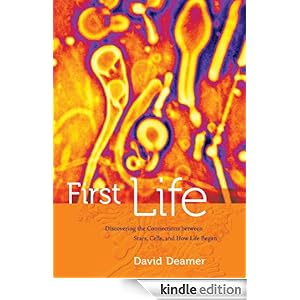
A few months ago I met the editor of Books & Culture (one of my favorite periodicals) at a meeting.  I told him that I've been a subscriber since the inception of the publication, and I'd love to write something for it sometime.  I had actually submitted a query two times before without much success, I told him.  Perhaps that got him to have some pity on a (very) minor scholar like myself, and he said he'd send me something sometime.  Well that time came a few weeks ago in the form of a book on astrobiology:  First Life, by David Deamer.  Understanding that I might not get another chance, I accepted the assignment to write a 1500 word review essay.  I turned it in this morning.  So hopefully it will be accepted and published in an upcoming issue.

"What do I know about astrobiology?" you may ask.  The answer is:  a lot more now than I did before.  Astrobiology pursues the twin goals of seeking life elsewhere in the universe, and trying to understand how life might have formed on our own planet.  I didn't actually engage the science of the book very much, because I'm certainly no expert on that.  Instead, I addressed the issue of how answering this question relates to the theological explanation of the origin of life of the planet, namely, God the Creator.  So the article was mostly some reflection on the relationship between scientific and theological explanations.  The short of it is: I don't think it poses a threat to our theology to also pursue scientific explanations.  Of course there can be points of tension between scientific and theological explanations, but as long as we're not dealing with scientists who are faithful followers of the quasi-religion of scientism, then there is plenty of space for us religious types to pursue theology as well.  

Sunday, May 18, 2008

Silence


I finished rereading Shusaku Endo's Silence last night (the first time I read it was in 2005). This strikes me as a very important novel--which probably doesn't mean anything more than, "I really like it."


Probably most of us have thought about what we would go through for our faith. Would we be able to die for what we believe? Would we go through torture and be martyred? As we see in Silence, those are the easy questions...


At the next level, would we allow others to be tortured because of our own faith? And, what does it mean to apostatize? Is there a difference between some external action that has always been associated with relinquishing one's faith and the internal commitment? How do we respond to God's seeming silence and indifference?


And perhaps most profoundly, what is the cultural garb of our faith?


I know that a few of you out there have read and appreciated Silence. I'd be interested to hear your takes on it.

Wednesday, July 25, 2007

Terrorist


When I travel through airports, I have a difficult time resisting some over-priced fiction at the book shops. On the way out to Portland, I picked up Terrorist by John Updike.

Last summer I tried doing a reading group with a couple of ex-philosophy students, but it fell apart when we picked Updike's Rabbit, Run (for reasons I'll leave to your imagination). Updike is one of those highly regarded contemporary novelists, and I've read a couple of his stories.

Well, this was not his greatest fiction. The supporting characters were under-developed and almost caricatures, and the plot was fairly predictable. But it was very interesting because you got into the head of the main character who is a Muslim teenager growing up on the outskirts of NYC. You could almost feel that it made sense for him to accept a suicide mission. Updike had certainly researched the Koran.

I don't know that I'd go so far as to recommend this as reading, but if you're looking to eat up some time between Minneapolis, Portland, Detroit, and South Bend, there are worse things you could do. Though I'll also admit that it makes you a little jumpy reading about terrorism as fly the friendly skies...