Showing posts with label novels. Show all posts

Friday, March 30, 2012

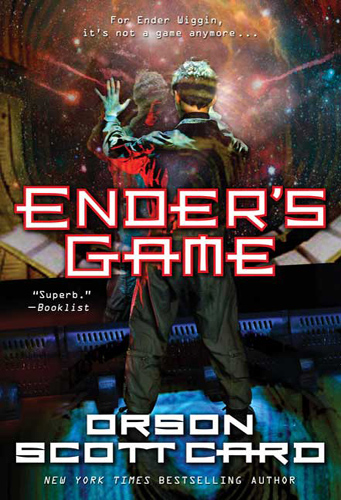
Ender's Game, thanks kids

My kids are all fairly avid readers, and of course they like the genre of science fiction and fantasy.  I like to stay informed of what these books are that they're into, so I ask them every once in a while what's the best thing they've read lately.  This last week all three told me I had to read Ender's Game, that it was very profound and they were sure that I'd like it.  I initially confused it with the current blockbuster movie, Hunger Games (based on the series they've also read).  But I was soon corrected that this book was not about children killing other children; it is about children pretending to kill other children as a way of practicing to kill aliens.

Ender is a young precocious boy who has been identified by the government of the future as one who might grow up to be a military commander in the impending war with the aliens who have already invaded twice.  So at the age of six he is removed from his family and sent to the space camp where he learns all sorts of military strategy, etc.  I suppose it is the "etc" that is the real story.

It really is a very engaging book.  I read through it in just a few evenings on the kindle.  There are some very satisfying twists at the end.  But it is not the plot that intrigued me most.  I read it as an indictment of the military mindset.  Of course the threat is very real, and something must be done.  But for someone whose only tool is a hammer, every problem looks a nail.  The military tears down Ender and builds him up to be the perfect military commander.  Ender realizes this but is powerless to do anything about it.  One of the most insightful and profound moments is when Ender confesses that he is such a good commander because he has the uncanny ability to empathize with the enemy, to think like they think.  His dilemma is that once you come to empathize with someone, you don't really want to destroy them.  Perhaps our military types would benefit from a little more empathy.

Thanks kids.  It was a good read.  I hope you'll read more like it.

Sunday, March 11, 2012

Finally Finished with Trollope

A few years ago I was at a conference on character education at Baylor.  Two of the main speakers were Stanley Hauerwas and David Solomon, and I heard both of them say that the best way to educate someone in character development would be to have them read a bunch of Anthony Trollope novels.  Never having read any Trollope, but usually appreciating 19th century literature, I came back and went to the bargain bookstore where I found a bunch of said novels (though I'm not sure the bunch I located was the right bunch...).

I was intrigued with the Barchester series he wrote, because supposedly it was inspired by the the Salisbury Cathedral in England (pictured), which I had visited recently.  It is a massive structure in an otherwise sleepy little town.  The events of the novels are structured around the ecclesial families of the town and the rather complicated relationship with the government.  I read the first book in the series, The Warden, pretty quickly and appreciated the moral dilemma the main character faced.  The other books were much longer, though, and so I put them off until some other time (though my wife read through a couple of shelf feet worth of these).

This past Christmas break I picked up the next one, Barchester Towers, and started in.  It didn't quite grab me, but I plodded on, ignoring Robby Prenkert's advice about reading things you're enchanted by.  There have been quite a few novels I've started and given 50 or 100 pages, and then called it quits because I wasn't enchanted (A Tale of Two Cities comes to mind here).  But this one, I felt I should keep reading because it wasn't just a diversion or entertainment, it was supposed to be character formation.  So, it stayed on my nightstand in the company of several other books that I dip into occasionally.  Well, finally I finished it yesterday, taking it with me to Ft. Wayne for a couple of my son's soccer games.  I'm guessing that the only character formation that happened was some bit of patience or perseverance.  Otherwise I was mostly annoyed with it.  Sorry Hauerwas and Solomon.  I'm on to other more enchanting books.

Monday, August 8, 2011

36 Arguments for the Existence of God

I got a Kindle for Christmas from my mother-in-law, and have used it with some regularity.  I've found that I'm not prepared to make the switch to that format for books that I'm studying--though I tried one, finding the highlighting and annotating ridiculously cumbersome.  But I've gotten the hang of reading novels on it fairly well.

I just finished today Rebecca Newberger Goldstein's novel, 36 Arguments for the Existence of God.  It's the story of a psychology professor who became an international sensation with his new-atheist-like book, Varieties of Religious Illusion.  But contrary to the real life new atheists, this guy is dubbed the atheist with a soul because while not believing, he is not dismissive of religion.  We don't get much of the content of his book, but evidently what makes him famous is the appendix to the book in which he lists 36 arguments and the problems with them all.  This appendix is reproduced in the novel, but unfortunately that doesn't display so well on the Kindle--at least it doesn't in the horizontal orientation that I like to read in... perhaps I should check the normal layout... nope, not much better.

There is a debate as part of the story at Harvard with a slick Christian, but most of the religious content centers around the conservative Hasidic community out of which the main character's family came.  Goldstein's own religious background is as an orthodox Jew, but now she's married to Steven Pinker, who if not one of the four horsemen of new atheism, he can certainly run with them.  She herself is a philosophy professor (and has written another book I've read, Incompleteness: The Proof and Paradox of Kurt Godel).  So this is pretty sophisticated stuff.  And stylistically, it is interesting: it does not follow a linear development, but keeps jumping back and forth in a way that gives you hints of what has happened and will happen.

It's worth a summer read.  It's probably not going to change anyone's mind on the existence of God, nor is it particularly illuminating on the role that arguments play in religious belief (though it does make some hints toward that).  I like a story with some substance to it.  If you know of others, send them my way.