Showing posts with label science. Show all posts

Tuesday, March 6, 2012

Disappointed with the Superstar

I was excited today to head across town to Notre Dame to hear one of the world's most famous physicists, Brian Greene.  The afternoon talk was at a colloquium for the physics department.  It was on the foundations of string theory, and pitched a level so that a scientific layperson like myself could follow it fairly well.  I thought it was one of the clearest presentations of why the majority of physicists see in string theory a real possibility of unifying quantum theory and general relativity.

But then he gave another lecture this evening that was pitched at the general audience.  He promised us at the beginning that he wasn't going off on some fringe tangent, but was presenting what mainstream physics accepts.  The first of these conclusions was that our world is actually just a holographic projection from the information stored on the edge of a black hole.  The second was that there is an infinity of worlds, and so among these you will find configurations of particles that resemble how the particles are configured in our world; so in some of these other "universes" there will literally be exact replicas of me sitting in an easy chair watching Top Shot and typing a blog on his laptop.  The last conclusion was based on the widely accepted theory that the universe is expanding faster and faster, such that at some point in the very distant future all of the other objects in space will have moved so far away and so quickly that the light will never reach our planet.  So the conclusion was the future inhabitants of our planet will be forced to conclude that their little chunk of matter is the only thing in the universe.

I was disappointed because this popularization strayed so far beyond the realm of what is empirically justified.  I understand that we often speculate, but it is irresponsible to present speculations as the most logical conclusions that we can come to.  There is a boatload of assumptions going on here, and it is irresponsible for scientists with so much respect and authority in our society to pass such stories off as the unquestionable truth.

End of rant.

Thursday, February 9, 2012

Einstein and Buddhism

I've been working on a paper for the upcoming Wesleyan Theological Society meeting on science and the religions of the world.  I've run into a problem that is typical of the research process:  tracking down a juicy quote.

It's always dangerous to let too much of your argument rest on quotations of others (lest it degenerates to mere appeal to authority), but sometimes just the right quotation will bolster a point.  One of the points I'm making is that throughout the twentieth century, there developed a certain fascination with Buddhism as the more fruitful religious conversation partner with science.  In this regard, there is a provocative quote attributed to Einstein that pops up all over the place (even in peer reviewed works):
The religion of the future will be cosmic religion.  It should transcend a personal God and avoid dogmas and theology.  Covering both the natural and the spiritual, it should be based on a religious sense arising from the experience of all things, natural and spiritual and a meaningful unity.  Buddhism answers this description. . . If there is any religion that would cope with modern scientific needs, it would be Buddhism.
The only problem with this is that Einstein probably never said it.  Rarely is there a citation for it, and when you do find a citation it is just some other secondary literature attributing the quote to him. The closest I've been able to find (after several hours of searching) is this from a piece he wrote for the New York Times Magazine in 1930 (tracked down for me by the good folks at the Bowen Library):
Indications of this cosmic religious sense can be found even on earlier levels of development--for example, in the Psalms of David and in the Prophets.  The cosmic element is much stronger in Buddhism, as, in particular, Schopenhauer's magnificent essays have shown us.
Still pretty good, but not quite the enthusiastic endorsement of the apocryphal version.  Perhaps more on this later if it turns out that I've begun another blogging phase.


Friday, August 5, 2011

Planet of the Apes

One of my favorite movies of all time (let's say top 20 at least) is the original Planet of the Apes.  It gave an interesting (if mostly one-sided) treatment of science and religion at a time when not many were talking about those two together.  And the macro-plot was so fascinating.  So when I heard that a prequel was coming out, I put opening day on the calendar.  And this afternoon, I took my boys to go see it.

I'll confess that I was a bit nervous about it.  The sequels to the original became more than a little goofy, as only the 70s could be goofy, and the remake by Tim Burton was visually nice but the story line was emasculated.  But I figured that if nothing else, it would be good for a few laughs.  We didn't laugh much.  This movie was frightening--frighteningly awesome, as my kids would say.

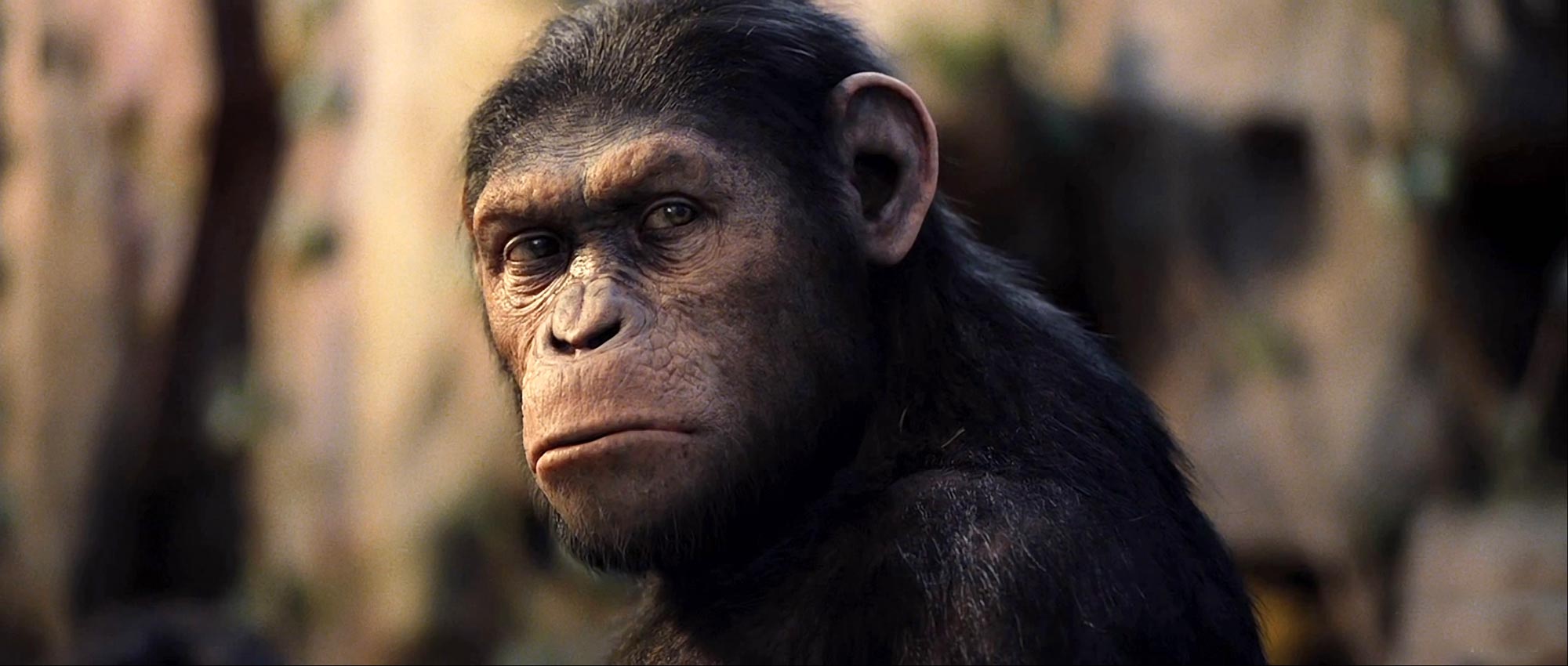
Rise of the Planet of the Apes is easily my favorite movie of the year--though admittedly, that isn't saying much.  But even if I had gone to see a bunch, I'm pretty sure this would still be my favorite.  Don't worry about spoiler alerts, because you know what's going to happen: the apes win.  And even just a little way into the movie, you know how they are going to win: there is a virus developed that causes brains to build a bunch of new synaptic connections and increase intelligence, but humans can't ward off the nastier element of the virus that kills them, while apes are immune to that part.  So essentially what we have is an event like the meteor crash that wiped out the dominant species (dinosaurs) and allowed the mammals to flourish.  But I don't suppose the dinosaurs sat around and reflected on the demise of their dominance or made movies about it.  And I guess that is what was so frightening and fantastic about the movie.  We were forced to so reflect.

The computer animation was stunning.  In the slower scenes, the emotion with which the primate faces is infused is incredible.  I thought some of the action scenes made the apes look too much like Spiderman, but I suppose we have to let Hollywood be Hollywood.  And it did a fantastic job of setting up the original--especially the subtle mention of a manned space mission that appeared to be lost.  The development of language was in there too in a climactic scene (though I understood that to be a physical--not mental--impossibility for apes). The film didn't pick up the religious themes of its predecessor/sequel, but certainly the animal ethicists will be happy.  How should we be treating these creatures who can obviously think and feel at significant levels?  They aren't so different from us, right?

Well, actually the real apes are significantly different from us.  Yes, they have the rudiments of intelligence, emotion, social structure, and even language.  But the complexities of these in us are such to put us on a completely different plane.  Some will want to emphasize that it is the imago dei that makes us so different.  But I'd suggest (without being too dogmatic about it) that that is getting the cause and effect switched around. Instead of the image of God that was somehow stamped onto us at some point and that making us different, I'd suggest that we as human beings were very different in kind and it is that that allowed us to enter into conscious relationship with God.  In that relationship, then, God allowed that we would be his image here on earth (rather than letting wood and stone idols be the image, like the gods of other Ancient Near Eastern religions apparently did).  Being God's image has nothing to do with what we look like, but rather we are the bearers of his character.  And I'd suggest that the character of God would be nice to the apes!

Saturday, July 30, 2011

What I've been Reading

A few months ago I met the editor of Books & Culture (one of my favorite periodicals) at a meeting.  I told him that I've been a subscriber since the inception of the publication, and I'd love to write something for it sometime.  I had actually submitted a query two times before without much success, I told him.  Perhaps that got him to have some pity on a (very) minor scholar like myself, and he said he'd send me something sometime.  Well that time came a few weeks ago in the form of a book on astrobiology:  First Life, by David Deamer.  Understanding that I might not get another chance, I accepted the assignment to write a 1500 word review essay.  I turned it in this morning.  So hopefully it will be accepted and published in an upcoming issue.

"What do I know about astrobiology?" you may ask.  The answer is:  a lot more now than I did before.  Astrobiology pursues the twin goals of seeking life elsewhere in the universe, and trying to understand how life might have formed on our own planet.  I didn't actually engage the science of the book very much, because I'm certainly no expert on that.  Instead, I addressed the issue of how answering this question relates to the theological explanation of the origin of life of the planet, namely, God the Creator.  So the article was mostly some reflection on the relationship between scientific and theological explanations.  The short of it is: I don't think it poses a threat to our theology to also pursue scientific explanations.  Of course there can be points of tension between scientific and theological explanations, but as long as we're not dealing with scientists who are faithful followers of the quasi-religion of scientism, then there is plenty of space for us religious types to pursue theology as well.  

Wednesday, June 1, 2011

Adam and Eve

I let my subscription to Christianity Today run out several months ago.  I wasn't happy that they seemed to interpret traditional orthodox Christianity as falling within very narrow parameters.  But it appears they've done something interesting this month.

I'd like to see what they said about Adam and Eve in the cover story.  Anyone read it and have reactions?  A thoughtful piece about it is here.

This is a topic from which we cannot run and hide.  And we can't answer the question merely by repeating the formulations of previous generations of orthodox Christians.  Maybe they were right, but like every generation, we've got work out the data of revelation in our context.

The evidence for early hominids is overwhelming now.  How do we fit this into our theology?  Of course it comes down to our biblical hermeneutic.  Do we think the Bible is a big book of propositions dropped from the sky?  Or is it the faithful (and authoritative) witness of communities with whom God interacted in a special way?  (I forget the name of the informal fallacy I just committed by making one of the options sound ridiculous.)  What difference does that make for interpreting it?  A pretty big one, I think.

Tuesday, May 13, 2008

Buddhism on the Brain

In today's New York Times there is an editorial by David Brooks (whom I know nothing about) called, "The Neural Buddhists." It discusses the move beyond materialism among the brain theorists (what we like to call "philosophers of mind") to the acceptance of the transcendent: "The mind seems to have the ability to transcend itself and merge with a larger presence that feels more real." He calls this "Neural Buddhism."

Brooks reads this shift as part of the culture war between a Christian worldview and a scientific worldview. But this one is not so much about atheism as it is about orthodoxy. He says, "The cognitive revolution is not going to end up undermining faith in God, it's going [to] end up challenging faith in the Bible."

A couple of (undeveloped thoughts):
1. The vast majority of scientists are not going about actively attempting to undermine Christianity or religion in general. There are only a few loud-mouthed ones with big book deals that are doing that. The rest go about their business trying to advance within their guilds by discovering new things.
2. There are two extremes we would do well to avoid: a) reading the Bible as a scientific textbook; b) thinking that revelation has no import for the larger worldview in which science operates.