Showing posts with label creationism. Show all posts

Friday, November 23, 2012

What is a Species?

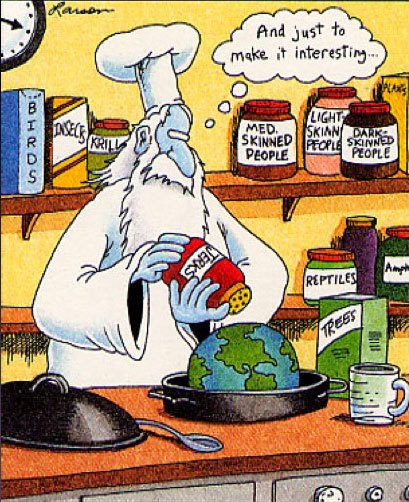
One of the difficulties encountered by those grappling with the implications of evolution is the attendant slipperiness the concept of a species.  It seems to us that we have no difficulty in recognizing that there are different kinds of things in the world:  here are trees, these are fish, over there are some potatoes.  But difficulties emerge when we zoom in and try to provide a more fine-grained analysis, because there appear to be some gray areas or borderline cases.  And the narrative arc of evolution maintains that things are subtly changing all the time, so that the fuzziness of defining a species occurs not only across similar organisms we find right now (for example, the Eastern meadowlark and the Western meadowlark), but also along the development of a family line through time (for example, those hominid fossils they keep digging up in South Africa)

A common way of giving a more precise definition of a species is to say that only members of the same species can mate and produce viable offspring which themselves can reproduce.  So horses and donkeys are not of the same species, because their offspring--the mule--is sterile.  But such a definition precludes asexual "species" like bacteria, and seems to miss what we intuitively feel are different species of plants that hybridize to form new species.  The young earth creationists prefer to use the term "kind" ripped out of its historical context and forced into scientific service, claiming that there is lots of adaptation and (micro)evolution within kinds (for example, all the present day dogs and wolves are descended from an original pair of canine-like ancestors on Noah's Ark).  But we have no operational definition of a kind that helps in identifying different kinds today.  Another approach might be to signify a certain range of variation in the DNA, and say that any organism whose DNA is outside that range is a different species.  But defining that range seems to be completely arbitrary (why not allow one more difference in base pairs??).

This discussion could go much deeper into the topic of evolution.  And perhaps one day I'll get bold enough to go there in these pages.  My interest in the discussion of species today is related to the philosophical topic of realism and nominalism.  That is to say, are there (objectively) certain kinds of beings in the world, or do we group individuals together using subjective conventions and call them a kind (when we might have grouped them in different ways)?  I like teaching about this topic in Intro to Philosophy, and I was reminded of it this morning when I stumbled across a dialogue written on a blog about the topic.  Here is an excerpt of it, with G being the realist and C the nominalist (warning: this is not Philosophy 101--more like 201):


G: I mean that man is inherently capable of reasoning. That that's the kind of being that he is.
C: I see. Well to me this entire “kind of being” notion seems like an an abstract invention. An intellectual trompe l'oiel.
G: Catullus, everyone believes in “kinds of beings.” You believe that an orange is different from an aardvark. That they're different kinds of things. By nature.
C: By convention. They are both basically assemblages of carbon atoms and H2O with a little of this and a little of that mixed in to give some local colour. The carbon and water and what-not are basically just wavelengths of a primordial energy that we call light. Our minds look upon the light and form the impression of a four legged eater of ants. Then we invent a word to group together similar impressions and thus, presto chango, the category of aardvark is produced.
G: Well in that case a human being is the kind of rational subjectivity that is capable of deducing aardvarks from the primordial light. He's still, by nature, a rational being.
C: So the objective truth is that a human person is an absolute subjectivity who uses his reason to produce reality and then imagines that his, or her, productions are objective. Yes, all right. I think I can agree to that.
 When I teach this topic in Intro to Philosophy, I'll illustrate the nominalist impulse by having students put ten American cities into two equal groups according to some logical criterion.  The cities are:  Atlanta, Boston, Cincinnati, Detroit, Kansas City, Los Angeles, San Diego, San Francisco, St. Louis, and Tampa Bay.  How would you group them?  Is there a correct way?  The obvious answer is that there is no one correct way to group them.  Is that the way everything works?

Nietzsche believed that any time we used a common noun like "leaf" we were destroying the individuality of things.  All the individual leaves or snow flakes are different (but imagine how long it would take me to say, "I'm going out to rake the leaves" if I couldn't lump all those individuals into one "kind"!!).

This isn't just some clever philosopher problem.  There are important implications to how we answer this question.  Since this post is already longer than most people will read, I'll leave it to you, dear reader, to tease out those implications.

Friday, November 16, 2012

Creationists R Us

Given the cablessness of our household vis-a-vis television (briefly described here), I've been getting more reading done lately.  My sports watching on the tube normally occurred with a book in my lap, but I'm pretty sure that I now have incontrovertible evidence that I do in fact read more quickly when I'm not watching TV at the same time.  Who woulda thought??

This week I got through one of those new books I got in the mail (mentioned here) a couple of weeks ago:  Among the Creationists: Dispatches from the Anti-Evolutionist Front Line.  It is by a mathematics professor at James Madison University by the name of Jason Rosenhouse, who is a self-professed atheist (though Jewish in cultural/religious background).  He got interested in creationism while holding a position at Kansas State University involved with implementing mathematics standards in public school education in Kansas.  He heard about a conference related to science education in Kansas, and on a whim decided to go.  It turned out to feature Answers in Genesis speakers like Ken Ham.  He reports from this conference, "It was clear that, from their perspective, evangelical Christianity was a tiny island of righteousness adrift in a sea of secular evil" (p. 3-4).  Thus began a fascination with that insular community by Rosenhouse, and he spent the next ten years going to their conferences.  The book is a collection of stories from these conferences and Rosenhouse's reflections on the movement.  He didn't become a Christian in the process, but some of his conclusions might surprise those who are members of the aforementioned insular community.  He says,
I do know these experiences have had a salutary effect on me.  It is far more difficult to caricature and stereotype people you have actually met.  Have a few conversations over lunch or during breaks at conferences, and suddenly they are no longer abstractions or types.  They are no longer defined by a few odd beliefs you have heard that they hold.  They become actual people, with depth and personality and reasons for the things they believe.  (p. 15)
The stories range through conferences like that one which was mostly propaganda, to the more scientifically serious conferences like the International Conference on Creationism, where credentialed scientists grapple with the science implied by their positions.  Rosenhouse discusses primarily the young earth variety of creationism, but also Intelligent Design and Evolutionary Creationism (aka theistic evolution).  No matter where you fall on that spectrum, the book is worth reading.  His treatment is fair and illuminating.  On this latter point, the book is like a mirror being held up to someone who hasn't seen himself for awhile--perhaps he was stranded on a desert island for some years; he probably knew that he looked different than the image of himself he carried in his head, but actually seeing himself the way others do is undoubtedly a little startling. Rosenhouse paints an accurate picture of the way many of us look to outsiders.

On the former point--fairness--we only have Rosenhouse's versions of his conversations and interactions, but they sound entirely plausible from my experience.  And he is very quick to say that to the surprise of many, he was always treated well at these conferences, he was never boo-ed or hooted off the microphone during the question answer sessions, people entered into dialogue with him and sometimes admitted when he had exposed a problem with their thinking.

I certainly don't agree with everything he says, but his conclusion needs to be taken seriously.  Here it is:
Evolution challenges the claims of the Bible, refutes Paley's version of the design argument, exacerbates the problem of evil, and seems to diminish human significance.  Any one of these points is worrisome, but all four together amount to a strong cumulative case against the possibility of harmony between evolution and Christianity. (p. 218).
We in the Church cannot ignore books like this.  On that count, I've been invited to talk to one of the large Sunday School classes at my church on Sunday about evolution.  The talk is not going to be of the sort that merely claims evolution to be absurd and ridiculous.  It's not (referent of the pronoun intentionally left vague).  We need to figure out what to do about it. 

Sunday, November 4, 2012

New Book Alert

Continuing one of my least popular series of blog posts, here are some new additions to my library that arrived in the mail this week.  Guess what I'm working on...

  • Among the Creationists, by Jason Rosenhouse
  • American Genesis: The Evolution Controversies from Scopes to Creation Science, by Jeffrey P. Moran
  • Science and Christianity in Pulpit and Pew, by Ronald L. Numbers
  • The Creationists, by Ronald L. Numbers
  • Science and Religion:  A New Introduction, by Alister McGrath
  • When Science and Christianity Meet, edited by David C. Lindberg and Ronald L. Numbers
  • God, Humanity and the Cosmos, edited by Christopher Southgate.Rocks of Ages: Science and Religion in the Fullness of Life, by Stephen Jay Gould