Showing posts with label women. Show all posts

Thursday, May 9, 2013

More about Women

In my post the other day (here), I just kind of snickered at the position John Piper takes on the role of women.  The position is obviously deserving of more careful engagement.  I don't have the inclination to do that myself, but I'll tell a story and then point to two others who have written more seriously about the topic.

The story has played itself out more than once and so I'll speak in generalities to protect the guilty.  I used to be involved in interviewing lots of people for jobs.  And given that hiring at a place like my institution has a faith/doctrinal component, questions would come up about topics that not all Christians agree on.  Sometimes that was the role of women.  Whenever that came up and the interviewee espoused the hierarchical/complementarian position advocated by Piper and his ilk, I'd ask why he or she held to that position.  Invariably the answer was "1 Timothy 3 clearly says that the overseers (or bishops or elders or senior pastors?) must be men."  Leaving aside the numerous counterexamples to the implied premise that "If the Bible clearly says something, we must do it or believe it" (e.g., Deut. 21:18-21, Mathew 5:29, 1 Peter 5:14), it is easy enough to expose the faulty thinking with their selective interpretation of that passage itself.  I ask, "So, can single men be elders?"  Because the passage clearly says that these overseers must be married.  "Can they be married without children?"  Because the passage clearly says that they have children.  "What if they only have one child?"  Because the passage clearly refers to children in the plural.  The most recent time this story played itself out, the interviewee (who was quite theologically sophisticated) responded with a somewhat nonplussed, "I've never thought of that."

Now just like other passages of scripture we ignore in their literal sense, there are reasons that can be given for why we should only take the maleness of 1 Tim. 3 as important.  The question is whether those are good reasons or not.  Here are couple of Baylor graduate students who have recently engaged the issue.

Rachel Pietka is a grad student in English and responds directly to Piper's podcast from a few weeks ago.  She wrote a blog post on the Christianity Today "Her-Meneutics" portal about why Piper's position reduces to his problems with the female body.  You can find it (the blog, not the female body) here.

And a doctoral student in theology at Baylor, and a figure known to many of the readers of this blog, David C. Cramer has just recently had a paper published called "Assessing Hierarchist Logic: Is Egalitarianism Really on a Slippery Slope."  You can find a copy of it here.  It has received significant attention in the blogosphere because of an entry yesterday on Scot McKnight's very popular blog (here), which McKnight concludes with these words: "For those with a mind to listen, this will be a landmark article demolishing the logic of one man’s attempt to right the ship."  I'm particularly proud of this landmark article and its use of careful logical thinking, because I taught the author logic in his undergraduate education!  (though if truth be told, I suspect that logical insight is more a function of nature than the nurture that comes from a couple of undergraduate courses).

Monday, May 6, 2013

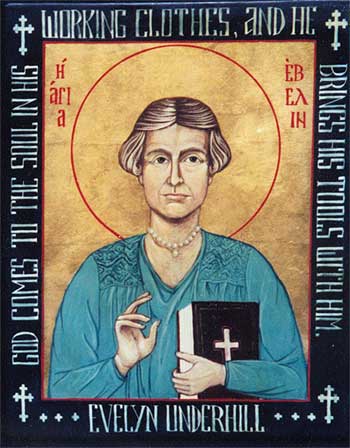
Piper on Women, Underhill on Prayer

John Piper was recently asked whether it was OK for men to read biblical commentaries that were written by women. (Find the podcast here.) He ruled that it is probably OK to read them as long as the women aren't there physically to assert their leadership or authority over a man directly.  Evidently indirect influence of an absent woman won't stain us men too badly or otherwise overturn the cosmic hierarchy God established, so I felt the freedom to read a book by a woman.  Instead of a commentary, I opted for a devotional classic in the mystical vein, assuming that Mr. Piper would put them into the same category.  The book is Evelyn Underhill's The Spiritual Life, and I feel that I've protected myself adequately from her direct influence since she has been dead for 70 years.

I think her words on the nature of prayer are particularly insightful:
"For prayer is really our whole life towards God: our longing for Him, our 'incurable God-sickness', as Barth calls it, our whole drive towards Him.  It is the humble correspondence of the human spirit with the Sum of all Perfection, the Fountain of Life.  No narrower definition than this is truly satisfactory, or covers all the ground.  Here we are, small half real creatures of sense and spirit, haunted by the sense of a Perfection ever calling to us, and yet ourselves so fundamentally imperfect, so hopelessly involved in an imperfect world; with a passionate desire for beauty, and yet unable here to realize perfect beauty; with a craving for truth and a deep reverence for truth, but only able to receive flashes of truth.  Yet we know that perfect goodness, perfect beauty, and perfect truth exist in God; and that our hearts will never rest in less than these.  This longing, this need for God, however dimly and vaguely we feel it, is the seed from which grows the strong, beautiful and fruitful plant of prayer.  It is the first response of our deepest selves to the attraction of the Perfect; the recognition that He has made us for Himself, that we depend on Him and are meant to depend on Him, and that we shall not know the meaning of peace until our communion with Him is at the centre of our lives."  
Thank you Evelyn.  Too often I sense the half-reality of my own existence and take it for the real thing, dismissing the haunting of the Real as nothing more than wishful thinking or the effects of some bad guacamole.  May my attraction to the Perfect, my communion with the One who made us all for Himself, my life of prayer, be kindled anew this summer.

Wednesday, May 30, 2007

Women and Men

Over Memorial Day, we were staying at my parents' cabin down toward Ft. Wayne. For Sunday morning we decided to go to a local church. I like showing up at a place where no one knows me and seeing how other places worship.

The kids were very nervous. Even after promising that we wouldn't make them go to some class on their own, but we'd all sit together in the pew (or individually stackable, padded chairs arranged in rows), they were still sure it was going to be a place full of 85 year olds wearing suits and ties and listening to pipe organs.

Well, we were pretty close to the middle of nowhere, but we found a "Community" church with a service at 10:00am. We arrived right as the service was starting and heard drums and guitars going. The first people we saw were in blue jeans and shorts. There was a themed service going on, complete with a large set built on stage for visual cohesiveness, a drama, special music by the full band that felt like a concert, and a video presentation. In short, it felt about like most growing, suburban churches. The kids were at ease.

The theme for a few weeks was "Desperate Households" modeled after the TV show by a similar name. The scripture text was Colossians 3:18-19, "Wives, submit to your husbands; husbands love your wives." The pastor had some very good things to say about interpersonal relationships between spouses, and I was personally challenged to be a better husband. But there's something about the exegesis of this passage that is always so glaring in omission. For we got the typical take on it in which women are encouraged to let men lead like they should, and this is not oppressive to women because men really are charged with the more difficult task of loving (of course this is something of a caricature; again, he had some very good things to say).

Now, I have few doubts that first century Roman Empire was a very patriarchal culture, and I'm not trying to twist the text to make it sound otherwise. But as we try to appropriate the meaning of the text for today, does anyone seriously doubt that wives are also called to love their husbands? And if that is the case, doesn't it seem reasonable that husbands might also be called to submit to their wives? On this interpretation, wives are being told what they need to hear especially, and husbands are being told what they need to hear especially. Look at almost every TV commercial involving a married couple and see who is the mature, dominant one; to this model of spousal interaction, I think Paul would say, "Ladies, ease off a bit and make the guys step up." When we get down to reality, most guys don't have much trouble submitting and letting their wives call the shots and run the family. Most guys do, however, have trouble showing genuine love for their wives--and their wives need this. Hence Paul's injunction to them.

The model of mutual submission and mutual love needs to be upheld as a model for marriage. We can learn something from the Trinity in this.