Showing posts with label teaching. Show all posts

Saturday, May 4, 2013

Summertime

My grades are turned in.  I'm not sure yet how much of a difference that will make in my blogging life, but it will certain make a difference in my real life.  The rhythm of the academic life is one of the great benefits of this line of work as I see it (though certainly second to the opportunity to mold young and impressionable minds).  We professors work pretty hard (or at least we should).  I challenge anyone who thinks that twelve hours of teaching per week is cushy, to see what it's like to prepare to stand up in front of (at least some) bright students and have something meaningful to talk about for a couple of hours each day.  Of course disciplines differ in this regard.  In my discipline (the mother of all disciplines... at least according to us), the situation is compounded by the fact that we don't have ready-made lesson plans, problem sets, or laboratory exercises.  Philosophy is pretty abstract stuff, and it takes a good deal of coaxing (and bribing and threatening) to get students to read some old text and to think carefully about the nuances of it so that the classroom experience will be more than just the sound and fury of my own voice.  Then there is the grading.  Philosophy doesn't lend itself to true or false tests, so it takes some time to assess students' work fairly.  But enough of the pity party for me.  I turned in my last grades yesterday, and my contract says I don't have to report back until the middle of August.

Except that the philosophy professors have to write an assessment report on the major and get it turned in to the powers that be.  And I'm on two different committees that have regular meetings and side work over the summer.  And since salaries keep slipping further behind the norm, I signed up to teach a May term class in which we do a week's worth of work every day in order to cram a semester into three weeks.  And I'm under contract to write a book by the end of next summer, and so need to make some good progress now to avoid 60 hour work weeks next year.  And I've got a couple of new courses in the fall to prepare for.  Yada yada yada.

Still, summer brings a change of pace.  Just like I'd get pretty tired of living in a climate where the weather is always the same, I'd quickly become burned out in a job where the work is always the same.  And I generally like the stuff I have to do.  It is a blessing to be able to make a living doing something you enjoy.  

Tuesday, March 27, 2012

Christian Thought

Blogging has been on the back burner the last ten days.  I typically fit it into my schedule during one of the lulls that are not entirely uncommon in my line of work.  It is not as though there are times when there is nothing to do (there is always something to do, as my inbox attests).  But there are times when there is no impending deadline that has you scrambling to stay on top of things.  Unfortunately, such times have been rare the last few weeks.

Since after spring break, I've had another class added to my teaching load--one of those intensive six or seven week graduate classes that meets one night per week for four hours at a whack.  For some people who have never done it before, teaching (especially at the college level) seems like a pretty good gig.  This semester I'm only in the classroom ten hours per week.  But if you think that a pastor typically prepares most of the week to stand up and talk in front of people for 30 minutes, the prep time can be pretty intense--especially for a graduate level course.  (Sorry all you pastors out there, I know you do lots of other things beside preach. . . but come to think of it, so do I: grading, committees, assessment of programs, direct an honors program, mentor students...)

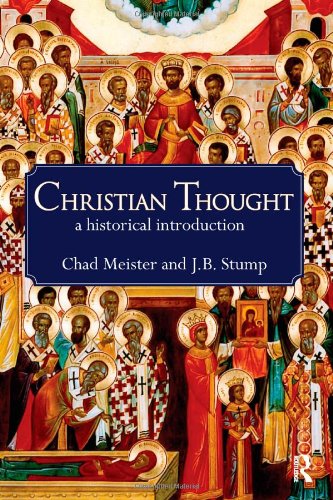
Now, you'd think that this graduate class would be a breeze to teach, because it is on the history of christian thought--a topic about which I've written a book.  And for the first time, I'm actually using my book as the textbook for the class.  But here's the interesting thing: I feel like I'm learning by reading through this book again.  I come upon some passages where I think, "That's a good point; I've never heard that before."  How quickly our knowledge fades!  This makes you think that if acquisition and retention of knowledge were the sole point of education, then we're probably not doing such a good job of it.  I'd be among the first to argue, though, that the central aim of education is something deeper than acquiring knowledge.  It is the process that does something to you.  Skills are learned, character is formed.  And you really do gain some knowledge--some of which sticks (it's not like I've forgotten everything in that book).

Anyway, IMHO I think this is a pretty good book.  You can still find it for a slight discount here.  Or I can make you an even better deal on one that is signed by both the authors.  The publishers will be releasing the 2011 sales figures next month, along with royalty checks.  The deal with the family is that when I get such a check, we go out to dinner.  I'm anxious to see if it will be at a dining establishment that doesn't have a drive-thru.

Saturday, May 12, 2007

Teach them to obey

"Teaching them to obey all that I have commanded." I talked about this briefly on Thursday. This is the last of those participial phrases in the Great Commission. The verb of the sentence in Greek, of course, is not "go", but "disciple" as in "to disciple". So a very literal translation might be something like,
"(As you are) going, therefore, disciple all the ethnic groups, baptizing them into the name of the father, and of the son, and of the holy spirit, teaching them to obey all that I have commanded you."

So, he's talking to the eleven disciples here. So the operative question should be, what were the things that he had commanded the disciples?

The first thing Matthew records Jesus saying is to John the Baptist, convincing John to baptize him. If if we construe John to be one of Jesus's disciples, it doesn't seem that this would be one of the commands we're to teach would-be disciples to obey. Jesus has already been baptized, and we don't have to do it again.

The next conversation in Matthew is with Satan in the desert. So these commands again are not the ones we're to teach people to obey. Then he begins his public ministry, proclaiming (to anyone who would listen?) "Repent for the kingdom of heaven has come near." I'd still like to claim that we're not yet talking about the commands in question, for this is more of a general call.

Then, he calls some disciples. This sounds promising. "Follow me," he says to Peter and Andrew. This was a fairly literal command, because these guys (and then James and John after them) stopped what they were doing and started following him around. I guess our challenge now is to translate this to our age: what does it mean to follow Jesus, and how do we teach people to obey it? I'd suggest that Jesus gives us some help here, because the next time Jesus's speech was recorded it is the Sermon on the Mount. And I guess I always had this idea that this was a sermon to a whole bunch of people. But the text is a bit ambiguous on this. For there were crowds around him, it says, and when he saw them he went up the mountain and sat down. Then his DISCIPLES came to him and he taught THEM.

If we take the unity of the book of Matthew seriously, I'd suggest that we ought to take very seriously the commands found here as the prime candidates for what Jesus wanted his disciples to be teaching his future disciples to obey. We'll explore what this might mean in the future.

Thursday, May 10, 2007

Is the Church Held Accountable for its Mission?

I spent the whole day at work schlogging through our institution's self-study. Once every ten years (if all goes well) the regional accrediting agency comes around to check to see whether we're doing what we say we're doing. In advance of this we have to prepare several hundred pages of documentation and reflection on how well we're doing. It's really a pain in the posterior, because tending to your mission is different than documenting or proving that you're tending to your mission. However, there is something about having someone check up on you that makes you do things better and more responsibly.

I got thinking, "What if churches had accrediting agencies?" I guess those that are part of denominations in some sense do have a regulatory body, but I'd bet that there is not a lot of rigor with regard to the expectations.

What if Jesus showed up occasionally to see how we're doing with regard to the mission he left us? The Great Commission in Matthew has four components to it as normally translated:
  1. Go into the whole world;
  2. Make disciples of everybody;
  3. Baptize them in the name of the Father, Son, and Holy Spirit;
  4. Teach them to obey all that I have commanded.

When people talk about the Great Commission, they rarely make it to #4. What if the accrediting agency came around to our churches to check up on this one? Disregarding for the moment all of those people who aren't in the church (whom we're supposed to be going to, discipling, and baptizing), could we demonstrate that those who are in our churches have been taught to obey all that Jesus commanded? Notice that this is not just teaching them what the commands of Jesus are (though we might not do so well on this easier task either). Rather, we have been charged to teach people to obey.

I'd even like to claim that it is not just declaring to people that they ought to obey the commandments. If I were writing a Message-esque paraphrase, this passage would be rendered, "Teach them how to obey all that I have commanded." For that is the sense of what Jesus is expecting. And these were pretty tough commandments: Love your neighbor, love your enemy, bless those who curse you, turn the other cheek, be perfect, etc. Have we been teaching people how to do this stuff? This is the beginning of spiritual formation.

Monday, April 30, 2007

Christian Higher Ed

During the past two days, I was privileged to announce the names of just over 500 students (minus the few who didn't show) who graduated from Bethel. We had beautiful weather in Northern Indiana for the ceremonies, and good times were had by all.

Of course I get all reflective on such an occasion. Many of the students walking across the stage were so great to have as students. We're very proud of the kind of people they've become. And there were a few of the others... I like the metaphor of the gardener or farmer for education. We're beyond the days of indoctrination and forcing students to adhere to sets of dogma (both religiously and disciplinarily); but there is a desired outcome, the kind of crop we're trying to raise. And so we aim to create the kind of conditions where that particular sort of crop flourishes. Using this kind of approach, there will be the rogue weed that sneaks through. But also our crop of graduates is healthier for having genuinely come to own the values rather than us force-feeding them.

Saturday, April 28, 2007

Spiritual Disciplines

I just finished teaching a six week class on the spiritual disciplines at NMC. It was designed to be a sampler class, exposing people to various disciplines with assignments to practice a different one each week. I've done such a class several times now, and it never ceases to amaze me at the outset how few of the evangelicals who've spent their whole lives in the church know much about the substance or purpose of the spiritual disciplines. By the end, though, I've yet to have a member of such a class believe the spiritual disciplines not to be worth pursuing as a component of a life of discipleship. Thoughts about the spiritual disciplines will be a prominent feature of future Stump Speeches. I believe them to be crucial.

For now, here's a quote from Amma Syncletica, a fourth and fifth century Desert Mother:

“It is dangerous for someone not ‘formed’ by experience of the ascetic life to try to teach; it is as if someone whose house is unsound were to receive guests and cause them injury by the collapse of the building… For the mere articulation of words is like the inscriptions painted in perishable colours which a very short period of time has destroyed with blasts of wind and splashes of rain. Teaching that is based on ascetic experience, on the other hand, not even all eternity could destroy. By chiseling away the rough edges of the soul, the spoken word bestows on the faithful Christ’s everlasting image done in stone.”

The Life of Blessed Syncletica, trans. Elizabeth Bryson Bongie (Toronto: Peregrina 1999) v. 79, 50.